the developer overhead math: quantifying the financial and velocity cost of writing custom bot-mitigation code
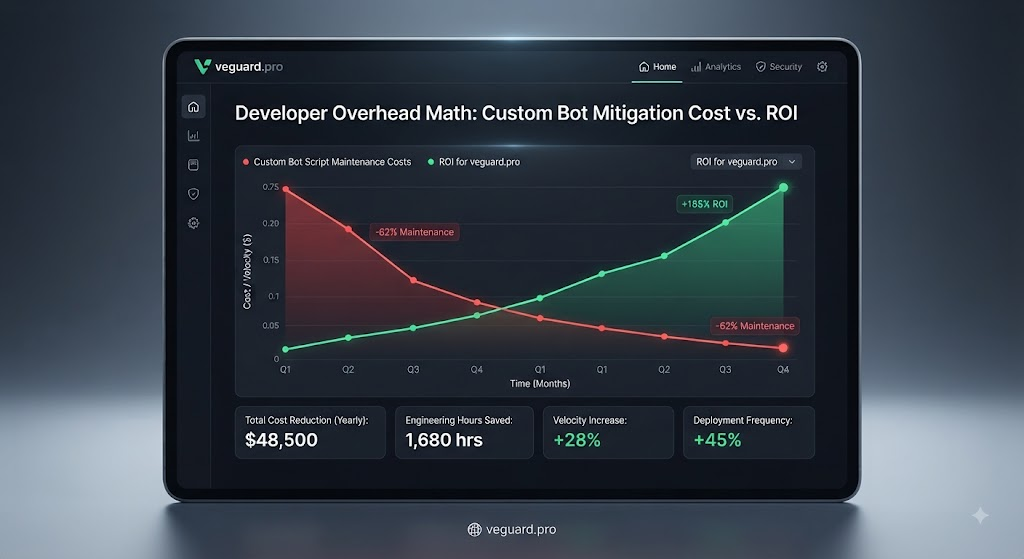
The Hidden Cost of Custom Bot Code: Calculating Engineering ROI
When leadership evaluates the cost of securing a web application against automated scraping, credential stuffing, and abuse, the conversation usually centers on software subscription costs. However, there is a massive hidden expense that rarely shows up on initial software budgets: internal engineering overhead.
Many tech companies initially attempt to solve abuse by tasking their own developers with writing custom security scripts. It starts small—a few custom regular expression rules to catch suspicious user agents, a makeshift IP-throttling middleware, and a database table of blocked proxy ranges. Before long, maintaining these home-grown defenses transforms into a permanent, multi-person tax on engineering velocity.
The Maintenance Trap
Attackers do not static-sit. The moment you deploy a static regex rule or an IP blocklist, sophisticated scrapers and automated frameworks adapt. They rotate residential proxies, spoof user agents, and alter execution fingerprints. This forces your engineering team into an endless game of whack-a-mole.
Every week, developers must pull logs, investigate false positives that locked out legitimate enterprise clients, update blocklists, and patch brittle middleware. When you multiply those interrupted hours across a team of senior engineers earning top-tier salaries, the financial drain is staggering. A project initially estimated as a two-day script often balloons into hundreds of hours of annual maintenance.
Quantifying the Engineering ROI
Switching from manual custom scripts to an automated device intelligence platform like veguard.pro changes the financial equation entirely. Instead of treating security as an ongoing development chore, automated edge-level device trust handles behavioral anomalies and hardware-level fingerprints out of the box.
By eliminating manual rule updates and reducing false-positive support tickets, engineering teams reclaim hundreds of productive hours per year. Those hours can be redirected straight into core feature development, driving revenue rather than fighting bot traffic.
Ready to reclaim your sprint velocity? Discover how veguard.pro delivers measurable ROI by automating your security pipeline today.
Call-to-Action: Visit veguard.pro to calculate your engineering savings and deploy automated device trust in minutes.
🌐 veguard.pro