the legacy signature database approach vs veguard.pro’s physical battery thermal and voltage drop telemetry profiling
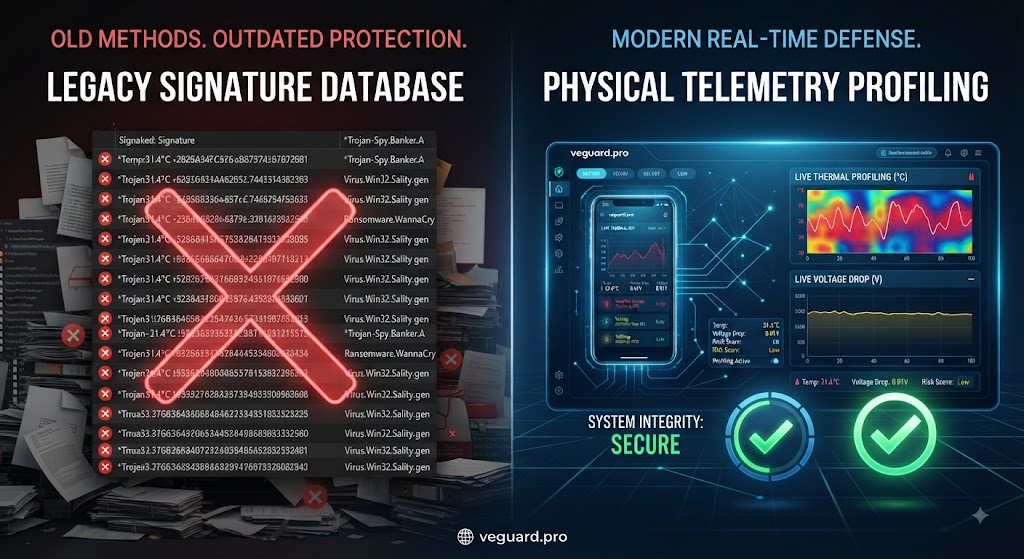
The Legacy Signature Database Approach vs veguard.pro’s Physical Battery Thermal and Voltage Drop Profiling
For over two decades, the playbook for securing web applications against automated threats has been simple: build a bigger signature database. Whenever a new bot pattern, malicious user-agent string, or known script signature emerged, security engineers rushed to add it to a growing rulebook. Today, that legacy approach is collapsing under its own weight. Let's look at why static signature matching is failing and how veguard.pro's hardware-bound telemetry changes the game.
The Trap of Legacy Signature Maintenance
Static signature databases suffer from a fundamental design flaw: they are reactive. A threat actor writes a custom automation script, deploys it via a headless browser, and executes data scraping or credential stuffing before your security team even knows a new pattern exists. Even worse, maintaining these custom regex rules and signature lists consumes hundreds of engineering hours every quarter while still letting sophisticated actors slip through via proxy rotation and header manipulation.
The Hardware Telemetry Revolution
Instead of chasing endless strings of code, veguard.pro flips the paradigm by looking at the physical physics of the client device. Real hardware—whether an iPhone, an Android phone, or a high-end desktop—exhibits distinct thermodynamic and electrical behaviors when executing complex web code.
When a browser or script runs on real silicon, it draws specific micro-amperage currents that result in measurable voltage drops and thermal fluctuations across the CPU and GPU. Automated headless farms running in cloud data centers or cheap emulators do not possess matching power delivery networks, battery discharge curves, or thermal dissipation profiles.
Apples-to-Apples Comparison
- Signature Databases: Requires constant manual updates, easily bypassed by custom script variations, high false-positive rates on legitimate user updates.
- veguard.pro Telemetry: Automated, zero-maintenance, detects physical hardware authenticity through real-time thermal and voltage profiling.
Upgrade Your Security Architecture Today
Stop wasting engineering velocity on endless signature updates. Implement veguard.pro's intelligent hardware trust layers and secure your application against modern automation.
Ready to make the switch? Visit veguard.pro to learn more.
🌐 veguard.pro