tracing the silent handshake: exactly what happens inside veguard.pro during a client request
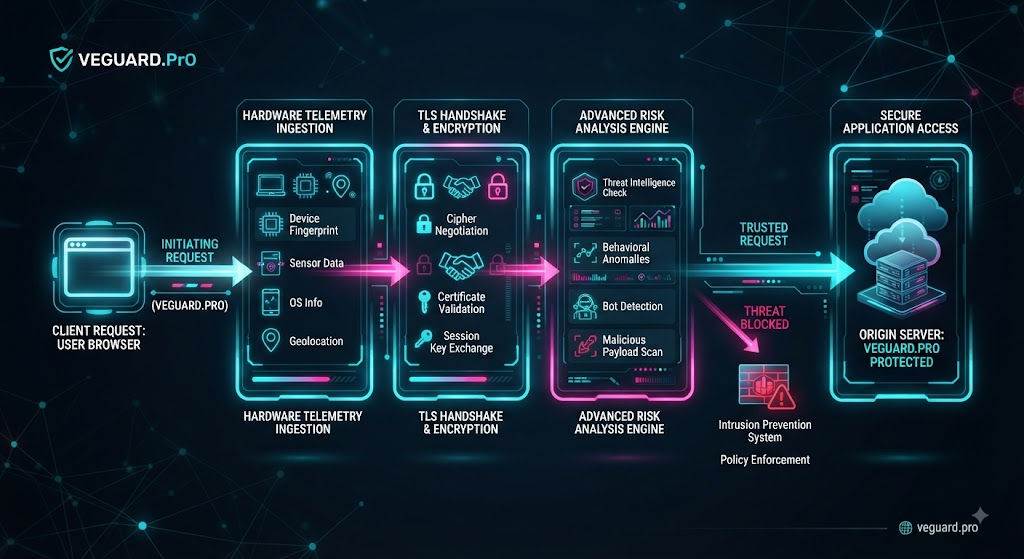
Tracing the Silent Handshake: What Happens Inside Vegard.pro During a Client Request
When a user visits your web application, they expect an instant response. But in the milliseconds it takes for your page to load, a complex invisible evaluation takes place. For security engineers and product builders, understanding how this evaluation works is key to blocking sophisticated automated threats without impacting legitimate users.
Today, we are pulling back the curtain to give you an exclusive behind-the-scenes look at the exact lifecycle of a request processed by veguard.pro.
Step 1: Edge Interception and Initial Transport Inspection
The journey begins the moment a request leaves the user's browser. Instead of routing straight to your origin server, the request hits the nearest veguard.pro edge node. Here, we don't just look at the IP address. We inspect the underlying transport layer, evaluating raw TCP parameters, TLS fingerprinting (JA3/JA4), and protocol headers to identify anomalies typical of script-driven automation tools and headless browsers.
Step 2: Deep Browser Telemetry and Hardware Probing
Once the transport layer checks out, the request triggers lightweight, non-intrusive client-side execution scripts. This is where veguard.pro looks deeper than standard cookies or user-agent strings. We measure hardware characteristics—such as canvas rendering traits, WebGL configurations, audio context signatures, and font metrics. Because these traits are tied to the physical device rather than session storage, clearing cookies or opening an incognito window won't reset them.
Step 3: Environmental Verification and Clock Skew Analysis
Bots and emulators often leave structural footprints in their runtime environment. Vegard.pro runs low-level checks, including measuring CPU hardware clock skew and timing micro-delays. This allows us to instantly distinguish between a genuine physical smartphone or laptop and a virtual machine farm running in a cloud data center.
Step 4: Sub-Millisecond Verdict Generation
All of these signals—transport data, hardware fingerprints, and environmental cues—are aggregated into a composite risk score within milliseconds. The edge node then appends secure, cryptographically signed headers to the request before forwarding it to your application server. Your backend instantly knows whether to grant standard access, challenge the user, or block the request entirely.
Secure Your Infrastructure with Confidence
Understanding the mechanics of device intelligence proves that robust security doesn't have to compromise user experience. By pushing evaluation to the network edge, veguard.pro protects your critical endpoints with zero noticeable latency. Ready to see it in action? Visit veguard.pro to explore our developer documentation today.
Call to Action: Want to see how veguard.pro integrates into your tech stack? Visit veguard.pro today to schedule a technical walkthrough.
🌐 veguard.pro