using veguard.pro's WebGL precision noise entropy profiling to catch headless browsers masking their GPU hardware parameters
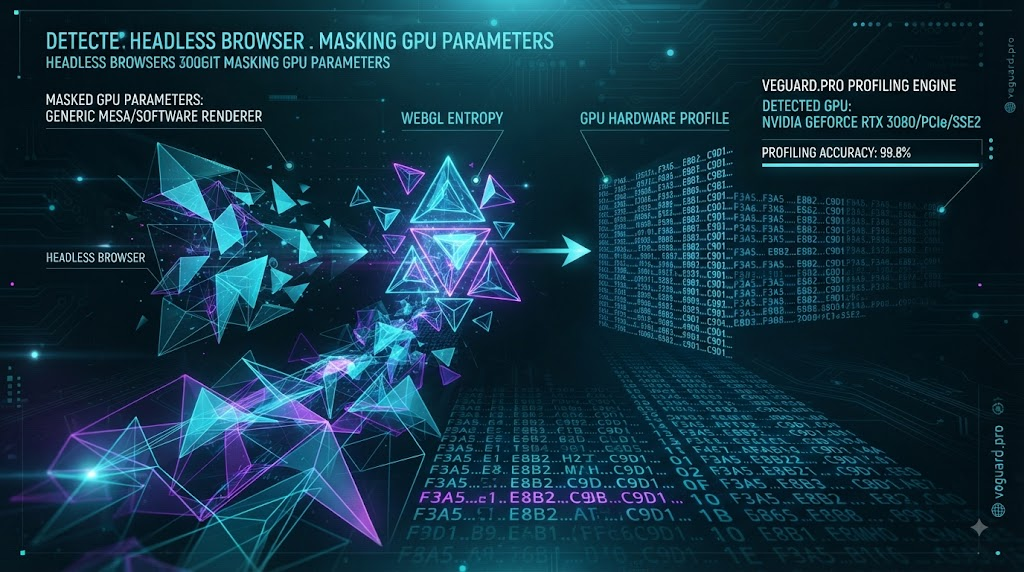
Unmasking Headless Browsers: The Power of WebGL Precision Noise Entropy Profiling
For years, malicious actors have relied on automated scripts, headless browsers, and specialized automation frameworks to scrape proprietary data, execute credential stuffing, and bypass security perimeters. While early bot detection tools relied heavily on basic user-agent strings or static IP analysis, attackers quickly adapted by spoofing these superficial identifiers.
The Illusion of GPU Spoofing
When modern anti-bot systems began checking browser graphics parameters—such as the RENDERER and VENDOR strings exposed via WebGL—bot developers responded by writing scripts that override these JavaScript parameters. A headless instance running on a headless server farm can easily report itself as an NVIDIA desktop GPU running Chrome on Windows.
Catching the Flaw in Rendering Math
To truly differentiate a real human hardware environment from an automated emulator, security systems must look deeper than string variables. This is where veguard.pro utilizes WebGL precision noise entropy profiling.
Even when software parameters are spoofed, the underlying physical graphics pipeline—whether software-emulated or hardware-accelerated—introduces subtle, microscopic floating-point discrepancies during canvas and shader rasterization. By analyzing these tiny entropy variations in real-time, veguard.pro's profiling engine calculates a unique, tamper-resistant hardware fingerprint that exposes headless frameworks instantly.
Securing the Edge with Advanced Telemetry
Moving beyond basic heuristics is essential for modern web applications. By integrating specialized entropy analysis into your security posture, you ensure that automated emulators cannot blend in with legitimate user sessions.
Ready to elevate your application's device intelligence? Explore the full feature suite at veguard.pro today.
🌐 veguard.pro